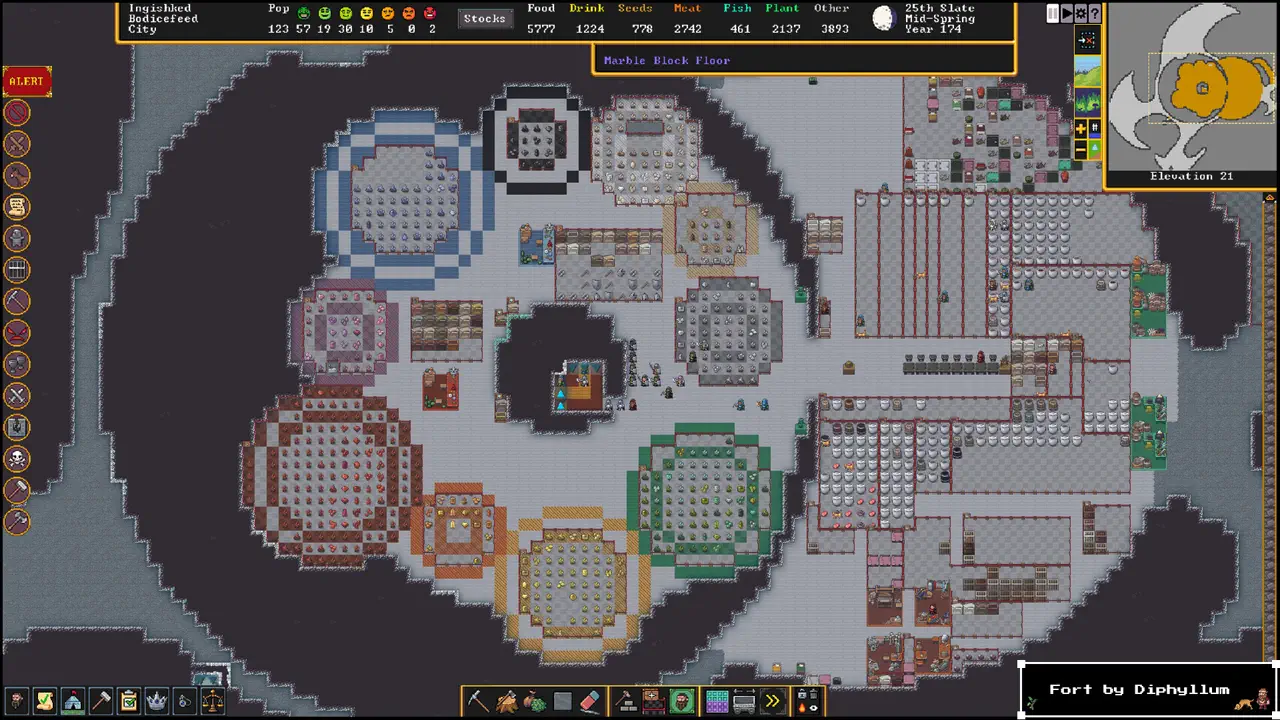
The Dwarf Fortress bolt thrower sits between two fortress instincts: the desire to automate danger away and the desire to watch a siege engine solve a very direct problem. After the Siege Update, bolt throwers became more important as part of active defense, especially for players who want alternatives to trap-only corridors.
This is not a magic answer to every invasion. A bolt thrower still needs planning: a safe crew, ammunition, a clean firing lane, protection from friendly traffic, and a defensive layout that makes enemies appear where the weapon can actually matter.
Where bolt throwers fit in defense
| Use case | Why it helps | Risk |
|---|---|---|
| Gate approach | Enemies crossing a long approach can be targeted before reaching doors. | Bad angles waste shots or endanger civilians. |
| Bridge or tunnel lane | Narrow paths make enemy movement easier to predict. | If the lane is breached, the crew needs a sealed fallback. |
| Layered kill zone | Bolt throwers add active damage before traps and melee squads engage. | Overbuilding one lane can leave other entrances weak. |
| Training and experimentation | A controlled design teaches siege engine behavior safely. | Complex setups can become maintenance chores. |
Design principles
- Give the weapon a straight, deliberate lane rather than a crowded general-purpose hallway.
- Separate the crew area from civilian traffic so a siege does not become a tavern accident.
- Add doors, bridges, or burrow controls so operators can retreat if enemies breach the line.
- Keep materials and ammo logistics close enough that the weapon is not idle when it matters.
- Use bolt throwers as one layer, not the whole defensive plan.
Example bolt thrower lane
A simple beginner experiment is a straight exterior approach, one sealed operator room, one controllable bridge or door before the lane, and a civilian burrow that excludes the whole entrance. The point is not to create the perfect death hallway. The point is to see whether the weapon fires, whether dwarves can operate it safely, and whether the fortress has a backup if the line fails.
| Part | Practical goal |
|---|---|
| Straight lane | Gives the bolt thrower a useful angle instead of a decorative corner. |
| Operator room | Keeps the crew away from the enemy path and civilian traffic. |
| Locked fallback | Lets operators retreat if attackers breach the lane. |
| Nearby ammo logistics | Reduces the chance that the weapon is idle during the one siege where it matters. |
| Burrow controls | Keeps children, pets, haulers, and tavern visitors out of the firing problem. |
Should every fortress use one?
No. A compact beginner fortress can survive with simpler defenses, squads, traps, drawbridges, and good burrow management. But if you are playing after the Siege Update and want to engage with the new defensive tools, a bolt thrower lane is one of the clearest experiments.
A bolt thrower is not a wall. It is a question you ask every invader walking down a straight line.
Use it when your fortress can support it: enough labor, enough metal or parts, enough safe architecture, and enough patience to test the lane before your survival depends on it.